Handheld Mini Fan OEM & ODM
A handheld mini fan does not cool the air — it moves it across skin, and the cooling comes from evaporation. That makes airflow and noise the only two real specifications, and it makes battery runtime the compromise that decides whether the product is useful on a hot day out.
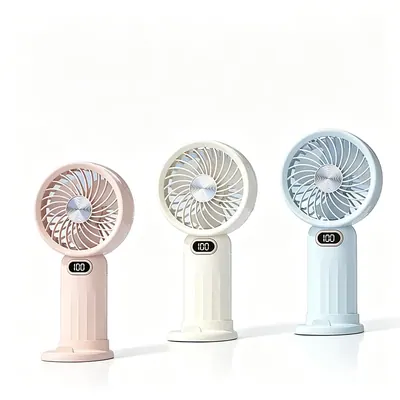
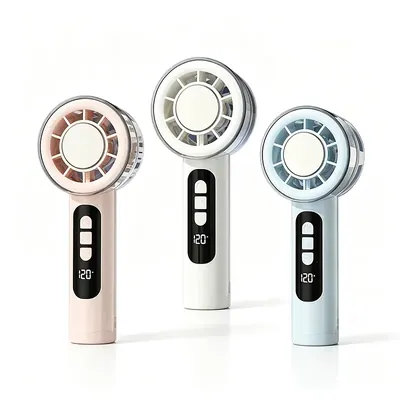
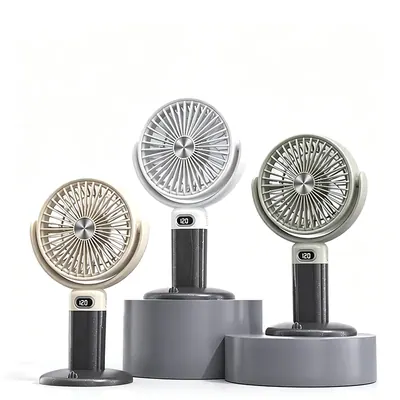
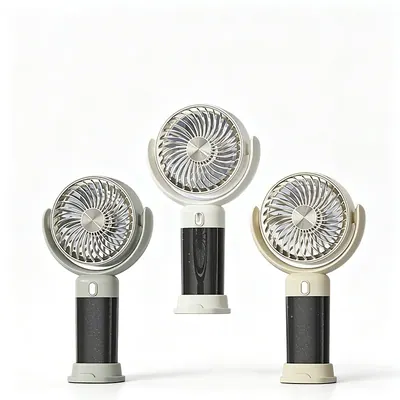
It moves air; it does not cool it
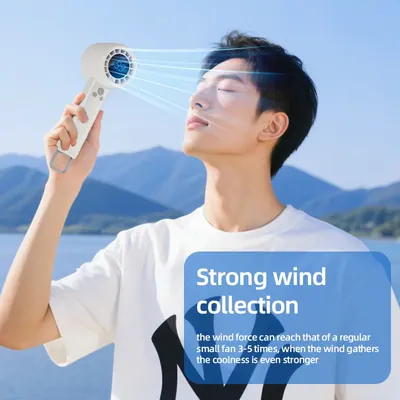
A personal fan's effect is convective and evaporative: moving air across skin increases heat loss, which feels like cooling even when the air temperature is unchanged. That is why a small fan feels effective in dry heat and nearly useless in humid heat, and why any claim about lowering room temperature is wrong.
It is also why airflow matters more than any feature. A unit that moves a gentle stream at 30 cm feels like nothing; one that moves a concentrated stream feels like relief, and the difference is the blade and the duct, not the battery.
Bladed or bladeless: two different products
A bladed fan uses a small high-speed impeller inside a housing; the better versions use a ducted impeller that concentrates the flow. A bladeless unit uses a small impeller in the base and a slot that entrains surrounding air, which gives a smoother stream at lower noise but costs more and moves less air for the same power.
For a handheld product the bladeless form is mostly a safety and appearance choice: no exposed blades for a child, and a cleaner look. The bladed ducted version is the better performer for the same money.
| Type | Airflow for the same power | Noise | Safety | Where it belongs |
|---|---|---|---|---|
| Open blades | High | Higher — turbulence at the tips | Exposed blades | Value, adult use |
| Ducted impeller | Highest | Lower | Grille needed | Mainstream and premium |
| Bladeless (slot) | Lower | Lowest | No exposed blades | Gift, child-safe, design-led |
Battery runtime is where the spec sheet misleads
Runtime is usually quoted at the lowest speed, where the fan is useless. The number that matters is runtime at the speed a person would actually use outdoors, which is often half the quoted figure or less.
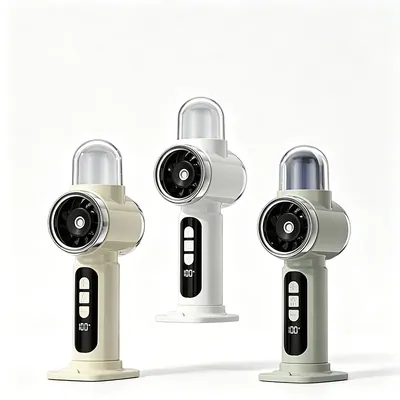
Charging is the second issue: a USB-C port with a proper charge controller and a battery indicator is worth more to the customer than a slightly larger cell. A unit that dies without warning is the most common complaint in this category.
The mount, the fold and the parts that break
Most of these products are used on a desk, in a pram or in a hand, so the stand and the fold joint matter. A friction hinge that loosens, or a clip that snaps, ends the product's life as surely as a dead cell.
The other failure is the switch, because the fan is switched on and off repeatedly. A membrane switch is cheaper and fails sooner; a tactile switch with a rubber boot costs little more and survives thousands of presses.
Battery shipping and market notes
| Market | Charging | What changes |
|---|---|---|
| EU / UK | USB-C | Battery transport documentation, WEEE, USB-C directive expectations |
| North America | USB-C | Battery documentation, UL-style marking for the charger if supplied |
| Japan | USB-C | PSE requirements if a mains adapter is in the box |
| SE Asia / Middle East | USB-C or micro-USB | Heat tolerance; cell ageing in a hot car or bag |
Handheld fan questions buyers ask
Does a mini fan actually cool a room?
No. It moves air across skin, which increases heat loss and evaporation. That feels like cooling, but the air temperature does not change, and in humid heat the effect is much smaller.
Bladeless or bladed?
Bladeless is safer around children and looks cleaner; a ducted bladed impeller moves more air for the same power. If performance is the priority, ducted blades win; if it is a gift or a child-safe product, bladeless.
Why does the battery die so fast?
Because runtime is quoted at the lowest speed. At a usable speed the figure is often half or less, and a small cell in a hot bag ages faster than the label suggests. A charge indicator prevents most of the complaints.
What should be measured on a sample?
Air speed at 30 cm on each setting, noise at 30 cm, runtime at the highest usable setting, and the number of switch cycles the mechanism survives.
Tell us bladed or bladeless, the runtime target and whether a child will use it, and we will quote the impeller and the cell as separate lines.
Need help choosing?
Send us the product type, target market and estimated volume — we will shortlist models and quote.