Fabric Cleaner OEM & ODM
A fabric cleaner is bought for sofas, mattresses and car seats, and it only earns its place if it lifts a stain without leaving a wet ring. That comes down to the spray pattern, the suction and the brush.
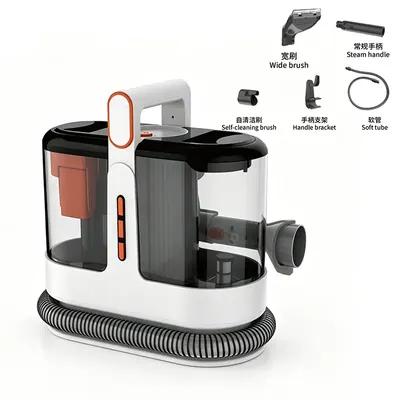
Spray, dwell and extract
The cleaning action is a sequence: solution is sprayed, it sits long enough to loosen the soil, and then it is pulled back out. A unit that sprays and extracts in the same motion cleans the surface and leaves the dirt behind. A trigger that lets the user spray, pause and then extract is the difference between a spot cleaner and a wet vacuum.
Suction is the other half. A strong motor with a narrow nozzle lifts more water; a wide nozzle covers more area but leaves the fabric wetter. For upholstery the narrow nozzle is usually the right choice, because the fabric cannot be wrung out.
The brush and the head shape
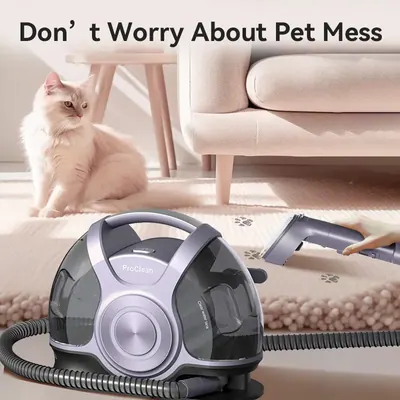
A brush that agitates the fibers lifts more soil, but a stiff brush on a delicate weave pulls threads. A removable brush, or a head with a brush strip that can be swapped, lets one unit serve upholstery and car mats without damaging either.
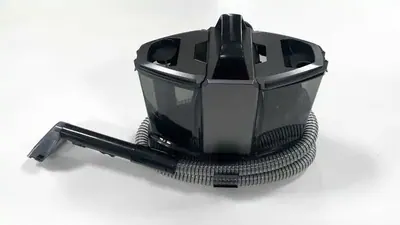
Head shape follows the surface: a narrow angled head reaches the crease of a sofa; a wider flat head covers a mattress faster. Two heads in the box is the configuration that sells best, because the buyer can see the two jobs on the carton.
Tank layout and what it means for use
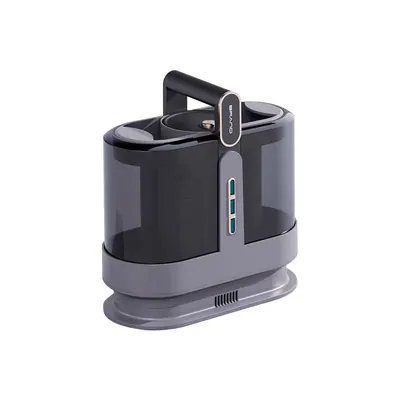
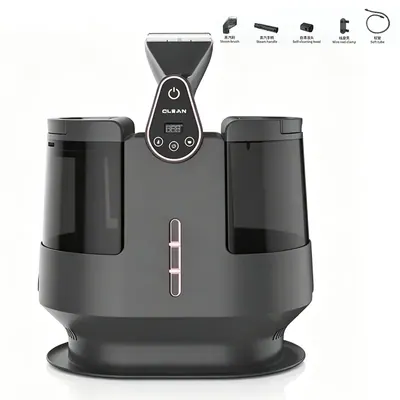
Separate clean and dirty tanks keep the solution away from the recovered water, and a dirty tank that opens wide is easier to rinse. A combined tank is cheaper to build but smells if it is not emptied immediately, which is the most common complaint in the category.
Cord length and hose length decide reach. A short hose limits the unit to the floor in front of it; a longer hose reaches a mattress or a car seat without moving the body. Around 1.5 m of hose is the practical minimum for upholstery.
Specification by market
| Market group | Voltage | Plug | Common format |
|---|---|---|---|
| UK / Europe | 230 V | Type G / Type F | Spot cleaner, two heads |
| 120 V markets | 120 V | Type A / Type B | Portable extractor, wide head |
| Japan | 100 V | Type A | Compact spot cleaner |
| Australia / NZ | 230 V | Type I | Spot cleaner with hose |
Private label decisions that show on the shelf
The two tanks are the product's visual story, so a transparent dirty tank shows the buyer what came out of the sofa. That transparency is a selling point and a manufacturing decision at the same time.
The carton should show a before-and-after on upholstery, with the two heads beside it. A sample solution bottle in the box is a low-cost addition that makes the first use immediate.
Fabric cleaner questions buyers ask
Can it be used on all upholstery?
Not on dry-clean-only fabrics. A unit with a low-suction setting and a soft brush is safer, but the fabric code on the label decides.
Why does the fabric stay damp?
Too much solution and too little extraction. A trigger that can be released before the suction pass is the fix.
Is a combined tank acceptable?
For occasional use, yes. For regular use the separate tank is easier to keep clean and does not hold odour.
Tell us the surfaces your market cleans most and the head set you want in the box, and we will quote the tank layout, the hose length and the carton together.
Need help choosing?
Send us the product type, target market and estimated volume — we will shortlist models and quote.